
Challenging behaviour is often viewed as something that needs to be managed.
However, when we shift our thinking to understanding behaviour as communication, we begin to see that many behaviours are actually a response to sensory overwhelm, unmet regulation needs, or environmental stressors.
Children do well when they can. When behaviour escalates, it is often because the child’s nervous system is struggling to cope with what is happening around them.
The good news is that small, thoughtful changes to the sensory environment can significantly reduce dysregulation and support children to remain engaged, calm, and ready to learn.
1. Reduce Visual Noise
Many early learning environments are filled with colour, displays, posters, and busy walls. While these are often created with good intentions, excessive visual input can overwhelm young children, particularly those still developing the ability to filter information.
When the environment competes for attention, children may struggle to focus, feel restless, or become easily frustrated.
Consider:
• limiting wall displays to meaningful learning documentation
• using neutral or natural backgrounds
• reducing clutter on shelves
• rotating resources instead of displaying everything at once
• creating calm spaces with minimal visual stimulation
Children often engage more deeply when there is less visual distraction competing for their attention.
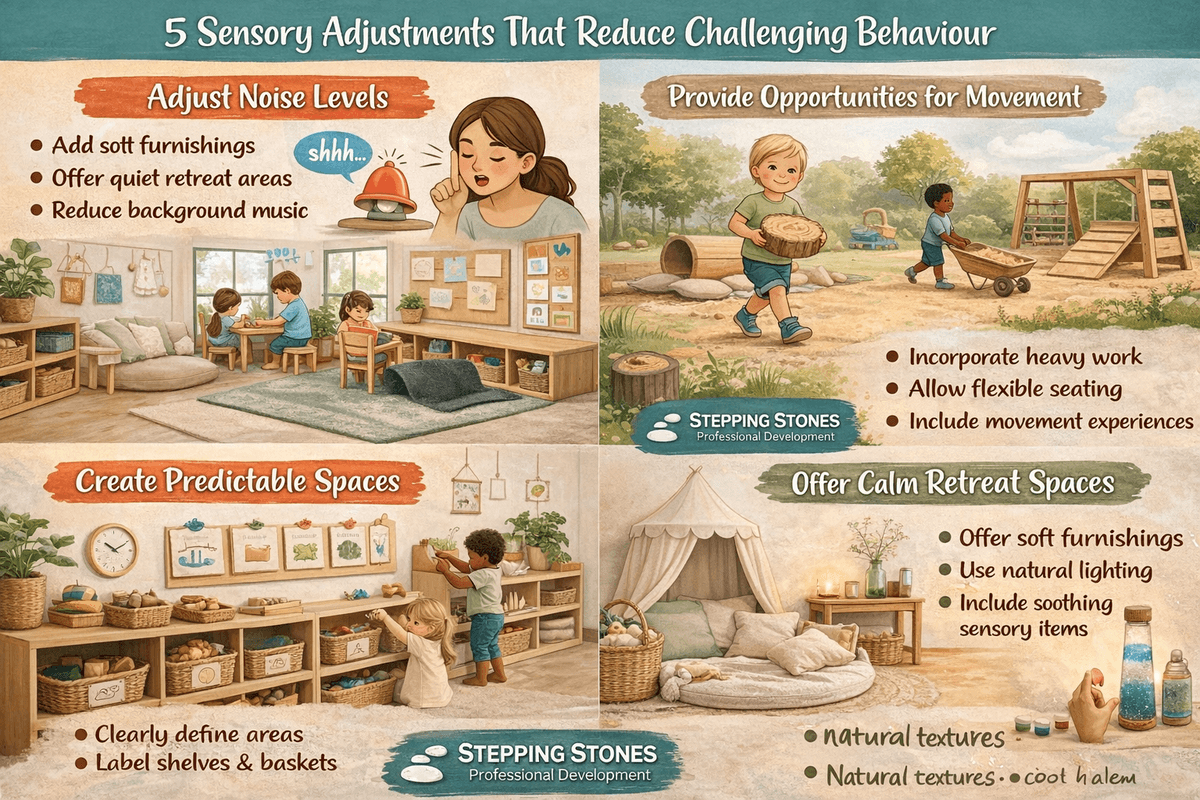
2. Adjust Noise Levels
Some children are highly sensitive to sound. Busy rooms, loud group times, scraping chairs, or competing conversations can cause sensory overload.
Noise does not always appear as distress — it may present as increased movement, calling out, withdrawing, or difficulty maintaining attention.
Consider:
• adding soft furnishings to absorb sound
• using rugs or felt under chairs
• creating smaller group spaces
• offering quiet retreat areas
• reducing background music where possible
A calmer sound environment can support children to feel safe and better able to regulate.
3. Provide Opportunities for Movement
Movement supports regulation. Children often seek movement when their bodies need support to organise sensory input.
When opportunities for movement are limited, behaviour may appear as fidgeting, climbing on furniture, pushing, or difficulty sitting for extended periods.
Consider:
• incorporating heavy work opportunities (carrying, pushing, lifting)
• providing access to outdoor spaces regularly
• allowing flexible seating options
• including movement experiences between transitions
• offering resources such as cushions, wobble stools, or resistance activities
Movement helps the nervous system feel organised and ready for engagement.
4. Create Predictable Spaces
Predictability supports a sense of safety. When children know where resources belong and understand how spaces are used, they can move confidently within the environment.
Unclear or constantly changing spaces can increase anxiety and uncertainty, sometimes leading to behaviour that appears resistant or unsettled.
Consider:
• clearly defined learning areas
• consistent placement of resources
• visual cues that support independence
• maintaining familiar routines
• preparing children for changes in the environment
Predictable environments allow children to focus on learning rather than navigating uncertainty.
5. Offer Calm Retreat Spaces
All children benefit from access to spaces where they can pause, regulate, and reset. These spaces are not a consequence for behaviour, but a support for emotional wellbeing.
Calm spaces help children recognise when they need a break and support the development of self-regulation skills over time.
Consider:
• soft furnishings such as cushions or beanbags
• natural lighting where possible
• calming sensory materials
• spaces that allow children to observe without being fully involved
• teaching children how to use the space proactively
Providing a calm retreat space communicates to children that regulation is supported and valued.
Final Reflection
Often, when we make adjustments to the sensory environment, we see a reduction in behaviours that previously required constant adult intervention.
Rather than asking How do we manage this behaviour? we might instead ask:
What is the environment communicating to the child?
When environments are thoughtfully designed to support regulation, children are more likely to feel calm, confident, and capable within their learning space.
Small changes can create significant shifts.
Janine Kelly

